


Basics#
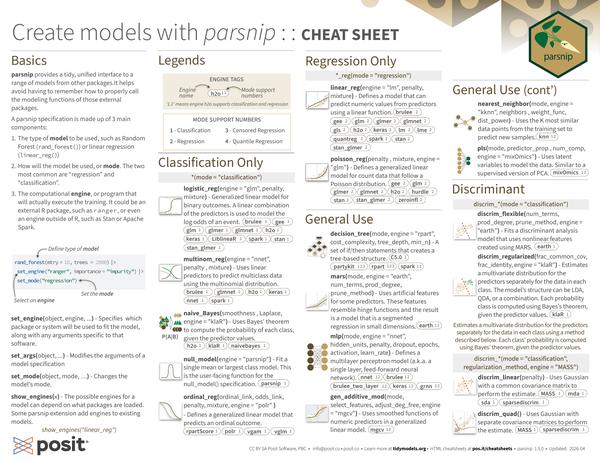
parsnip provides a tidy, unified interface to a range of models from other packages. It helps avoid having to remember how to properly call the modeling functions of those external packages.
A parsnip specification is made up of 3 main components:
-
The type of model to be used, such as Random Forest (
rand_forest()) or linear regression (linear_reg()) -
How will the model be used, or mode. The two most common are “regression” and “classification”.
-
The computational engine, or program that will actually execute the training. It could be an external R package, such as ranger, or even an engine outside of R, such as Stan or Apache Spark.
|
|
-
set_engine(object, engine, ...)- Specifies which package or system will be used to fit the model, along with any arguments specific to that software. -
set_args(object, ...)- Modifies the arguments of a model specification. -
set_mode(object, mode, …)- Changes the model’s mode. -
show_engines(x)- The possible engines for a model can depend on what packages are loaded. Some parsnip extension add engines to existing models.
|
|
Legends#
Mode Support Numbers#
- 1 - Classification
- 2 - Regression
- 3 - Censored Regression
- 4 - Quantile Regression
Engine Tags#
Engine tags show the engine name and mode support numbers. For example, h2o 1, 2 means engine h2o supports classification (1) and regression (2).
Classification Only#
-
logistic_reg(mode = "classification", engine = "glm", penalty, mixture)- Generalized linear model for binary outcomes. A linear combination of the predictors is used to model the log odds of an event.brulee 1 gee 1 glm 1 glmer 1 glmnet 1 h2o 1 keras 1 LiblineaR 1 spark 1 stan 1 stan_glmer 1
-
multinom_reg(mode = "classification", engine = "nnet", penalty, mixture)- Uses linear predictors to predict multiclass data using the multinomial distribution.brulee 1 glmnet 1 h2o 1 keras 1 nnet 1 spark 1
-
naive_Bayes(mode = "classification", smoothness, Laplace, engine = "klaR")- Uses Bayes’ theorem to compute the probability of each class, given the predictor values.h2o 1 klaR 1 naivebayes 1
-
null_model(mode = "classification", engine = "parsnip")- Fit a single mean or largest class model. This is the user-facing function for the null_model() specification.parsnip 1
-
ordinal_reg(mode = "classification", ordinal_link, odds_link, penalty, mixture, engine = "polr")- Defines a generalized linear model that predicts an ordinal outcome.rpartScore 1 polr 1 vgam 1 vglm 1
Regression Only#
-
linear_reg(mode = "regression", engine = "lm", penalty, mixture)- Defines a model that can predict numeric values from predictors using a linear function.brulee 2 gee 2 glm 2 glmer 2 glmnet 2 gls 2 h2o 2 keras 2 lm 2 lme 2 quantreg 2 spark 2 stan 2 stan_glmer 2
-
poisson_reg(mode = "regression", penalty, mixture, engine = "glm")- Defines a generalized linear model for count data that follow a Poisson distribution.gee 2 glm 2 glmer 2 glmnet 2 h2o 2 hurdle 2 stan 2 stan_glmer 2 zeroinfl 2
General Use#
-
decision_tree(mode, engine = "rpart", cost_complexity, tree_depth, min_n)- A set of if/then statements creates a tree-based structure.partykit 1, 2, 3 rpart 1, 2, 3 spark 1, 2 C5.0 1
-
mars(mode, engine = "earth", num_terms, prod_degree, prune_method)- Uses artificial features for some predictors. These features resemble hinge functions and the result is a model that is a segmented regression in small dimensions.earth 1, 2
-
mlp(mode, engine = "nnet", hidden_units, penalty, dropout, epochs, activation, learn_rate)- Defines a multilayer perceptron model (a.k.a. a single layer, feed-forward neural network).nnet 1, 2 brulee 1, 2 brulee_two_layer 1, 2 keras 1, 2 grnn 1, 2
-
gen_additive_mod(mode, select_features, adjust_deg_free, engine = "mgcv")- Uses smoothed functions of numeric predictors in a generalized linear model.mgcv 1, 2
-
nearest_neighbor(mode, engine = "kknn", neighbors, weight_func, dist_power)- Uses the K most similar data points from the training set to predict new samples.kknn 1, 2
-
pls(mode, predictor_prop, num_comp, engine = "mixOmics")- Uses latent variables to model the data. Similar to a supervised version of PCA.mixOmics 1, 2
Discriminant#
-
discrim_flexible(mode = "classification", num_terms, prod_degree, prune_method, engine = "earth")- Fits a discriminant analysis model that uses nonlinear features created using MARS.earth 1
-
discrim_regularized(mode = "classification", frac_common_cov, frac_identity, engine = "klaR")- Estimates a multivariate distribution for the predictors separately for the data in each class. The model’s structure can be LDA, QDA, or a combination. Each probability class is computed using Bayes’s theorem, given the predictor values.klaR 1
Estimates a multivariate distribution for the predictors separately for the data in each class using a method described below. Each class’ probability is computed using Bayes’ theorem, given the predictor values.
-
discrim_linear(mode = "classification", regularization_method, engine = "MASS", penalty)- Uses Gaussian with a common covariance matrix to perform the estimate.MASS 1 mda 1 sda 1 sparsediscrim 1
-
discrim_quad(mode = "classification", regularization_method, engine = "MASS")- Uses Gaussian with separate covariance matrices to perform the estimate.MASS 1 sparsediscrim 1
Support Vector Machine#
Classification: Maximizes the width of the margin between classes using a method described below.
Regression: Optimizes a robust loss function only affected by very large model residuals and uses an additional method described below.
-
svm_linear(mode, cost, engine = "LiblineaR", margin)- Classification: A linear class boundary. Regression: Uses a linear fit.kernlab 1, 2 LiblineaR 1, 2
-
svm_poly(mode, cost, engine = "kernlab", degree, scale_factor)- Classification: A polynomial class boundary. Regression: Uses polynomial functions of the predictors.kernlab 1, 2
-
svm_rbf(mode, cost, engine = "kernlab", rbf_sigma)- Classification: A nonlinear class boundary. Regression: Uses nonlinear functions of the predictors.kernlab 1, 2
Feature Rules#
-
rule_fit(mode, mtry, trees, min_n, tree_depth, learn_rate, loss_reduction, sample_size, stop_iter, penalty, engine = "xrf")- Derives simple feature rules from a tree ensemble and uses them as features in a regularized model.xrf 1, 2 h2o 1
-
C5_rules(mode = "classification", trees, min_n, engine = "C5.0")- Derives feature rules from a tree for prediction. A single tree or boosted ensemble can be used.C5.0 1
-
cubist_rules(mode = "regression", committees, neighbors, max_rules, engine = "Cubist")- Derives simple feature rules from a tree ensemble and creates regression models within each rule.Cubist 2
Ensemble#
“E Pluribus Unum”
-
bag_mars(mode, num_terms, prod_degree, prune_method, engine = "earth")- Ensemble of generalized linear models that use artificial features for some predictors. These features resemble hinge functions and the result is a model that is a segmented regression in small dimensions.earth 1, 2
-
bag_mlp(mode, hidden_units, penalty, epochs, engine = "nnet")- An ensemble of single layer, feed-forward neural networks.nnet 1, 2
-
bag_tree(mode, cost_complexity = 0, tree_depth, min_n = 2, class_cost, engine = "rpart")- Ensemble of decision trees.C5.0 1 rpart 1, 2, 3
-
bart(mode, engine = "dbarts", trees, prior_terminal_node_coef, prior_terminal_node_expo, prior_outcome_range)- Tree ensemble model that uses Bayesian analysis to assemble the ensemble.dbarts 1, 2
-
boost_tree(mode, engine = "xgboost", mtry, trees, min_n, tree_depth, learn_rate, loss_reduction, sample_size, stop_iter)- Creates a series of decision trees forming an ensemble. Each tree depends on the results of previous trees. All trees in the ensemble are combined to produce a final prediction.C5.0 1 catboost 1, 2 h2o 1, 2 lightgbm 1, 2 mboost 3 spark 1, 2 xgboost 1, 2, 4
-
rand_forest(mode, engine = "ranger", mtry, trees, min_n)- Creates a large number of decision trees, each independent of the others. The final prediction uses all predictions from the individual trees and combines them.aorsf 1, 2, 3 grf 1, 2, 4 h2o 1, 2 partykit 1, 2, 3 randomForest 1, 2 ranger 1, 2 spark 1, 2
Survival#
-
proportional_hazards(mode = "censored regression", engine = "survival", penalty, mixture)- Defines a model for the hazard function as a multiplicative function of covariates times a baseline hazard.glmnet 3 survival 3
-
survival_reg(mode = "censored regression", engine = "survival", dist)- Defines a parametric survival model.flexsurv 3 flexsurvspline 3 survival 3
Operations#
|
|
Methods#
-
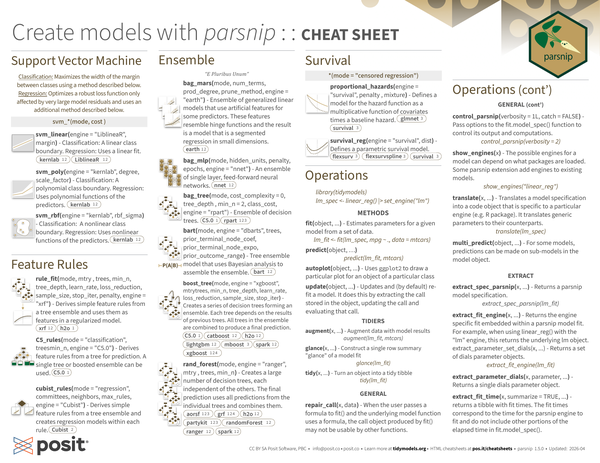
fit(object, ...)- Estimates parameters for a given model from a set of data.1 2 3lm_fit <- fit(lm_spec, mpg ~ ., data = mtcars) lm_fit -
predict(object, ...)1predict(lm_fit, mtcars) -
autoplot(object, ...)- Uses ggplot2 to draw a particular plot for an object of a particular class. -
update(object, ...)- Updates and (by default) re-fits a model. It does this by extracting the call stored in the object, updating the call and evaluating that call.
Tidiers#
-
augment(x, ...)- Augment data with model results.1augment(lm_fit, mtcars) -
glance(x, ...)- Construct a single row summary “glance” of a model fit.1glance(lm_fit) -
tidy(x, ...)- Turn an object into a tidy tibble.1tidy(lm_fit)
General#
-
repair_call(x, data)- When the user passes a formula to fit() and the underlying model function uses a formula, the call object produced by fit() may not be usable by other functions. -
control_parsnip(verbosity = 1L, catch = FALSE)- Pass options to the fit.model_spec() function to control its output and computations.1control_parsnip(verbosity = 2) -
show_engines(x)- The possible engines for a model can depend on what packages are loaded. Some parsnip extension add engines to existing models.1show_engines("linear_reg") -
translate(x, ...)- Translates a model specification into a code object that is specific to a particular engine (e.g. R package). It translates generic parameters to their counterparts.1translate(lm_spec) -
multi_predict(object, ...)- For some models, predictions can be made on sub-models in the model object.
Extract#
-
extract_spec_parsnip(x, ...)- Returns a parsnip model specification.1extract_spec_parsnip(lm_fit) -
extract_fit_engine(x, ...)- Returns the engine specific fit embedded within a parsnip model fit. For example, when using linear_reg() with the “lm” engine, this returns the underlying lm object.1extract_fit_engine(lm_fit) -
extract_parameter_dials(x, parameter, ...)- Returns a single dials parameter object. -
extract_parameter_set_dials(x, ...)- Returns a set of dials parameter objects. -
extract_fit_time(x, summarize = TRUE, ...)- Returns a tibble with fit times. The fit times correspond to the time for the parsnip engine to fit and do not include other portions of the elapsed time in fit.model_spec().
